
Gemini 3.8 TTS is for the people who never see your dashboard
Much of supply chain works with busy hands, busy eyes or a different first language. Google’s new text-to-speech models make a spoken briefing in every language on the line cost cents.

Practical books and first-app guides for supply chain professionals. From your first useful prompt to tools and agents you can trust.
From the blog
Short pieces on using AI in supply chain work: what I tried, what held up and what I would check before trusting it.
Read all postsMuch of supply chain works with busy hands, busy eyes or a different first language. Google’s new text-to-speech models make a spoken briefing in every language on the line cost cents.

A forecasting model that has never seen your sales history can now beat you on some items. Here’s how to find out which ones, in one afternoon.
Jev can only give answers you wrote down in advance. Here are ten places in a supply chain where that is exactly what you want.
Choose the right AI for your work. Then turn your next idea into a project you can put into practice.
Find what fits your supply chain.
Explore AI models and libraries by supply chain capability. Compare what they do, what they need, and how to put them to work.
Explore the model referenceTurn your idea into a brief you can build.
Create a product requirements document (PRD) that defines what to build, plus a clear instruction to implement it. Start with your goal and work through the details.
Explore the project plannerThe core series · Three books, one learning path
A three-book foundation for supply chain practitioners. Start with everyday AI practice, progress to tools your team can reuse, then bring knowledge and actions together in agents.
Browse all booksEach book has its own page with its contents, a preview and the exercises that go with it. The first book is free with an account; read it in the workbench or as a PDF.
Build a daily AI practice, a reusable prompt library, and a habit of checking results.
Specify, build, test, and share tools that work on your data.
Bring knowledge and tools together, with clear scope and human decision boundaries.
Specialist books
Go further into a specific supply chain discipline. Specialist books connect the business decisions with the models behind them, then help you build and verify tools you can understand.
Work through explanations, worked examples, and practical exercises at your own pace. Each title is a focused handbook you can return to when the problem calls for more depth.
Explore specialist books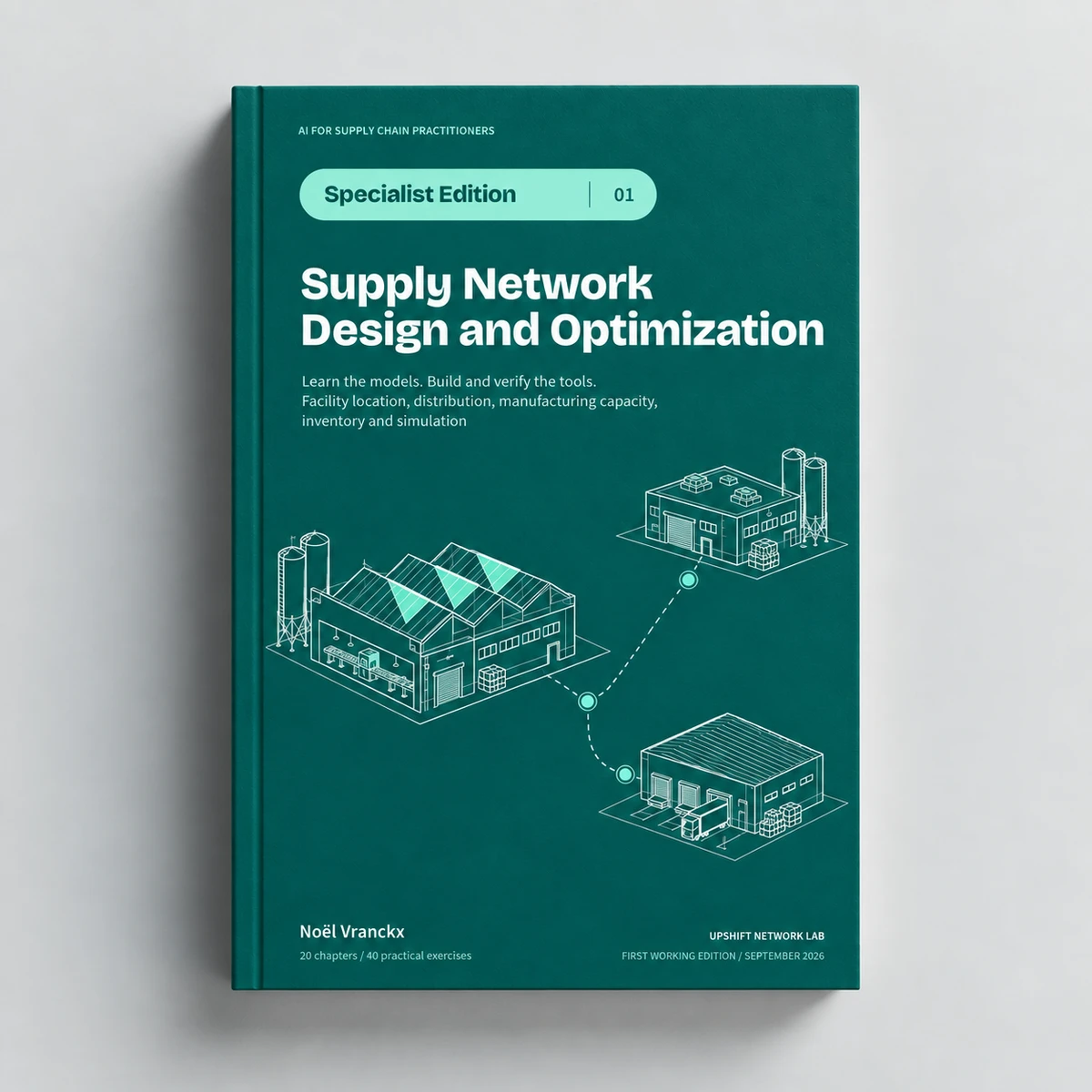
Specialist books
Specialist edition 01
Learn the models behind facility location, distribution, manufacturing capacity, inventory, and simulation. Build and verify the tools with 40 practical exercises.
Every book comes with exercises you do yourself. Read a chapter, then practise its method on realistic files until you can use it on your own work.
Work on data made for the exercise.
Each exercise comes with files from Upshift, the fictional bicycle company in the books: agreements, orders, emails and spreadsheets, ready to give your AI.
Know what to do next.
A walkthrough tells you what to give the AI, what to ask it, and how to check its answer against the sources.
See how your result compares.
Compare your answer with a worked reference, mark the exercise done, and follow your progress through the book in your workbench.
A useful task, the source material, and a way to check the result. These exercises include fictional practice files and worked references.
Recover the current position from 27 supplier emails. Check commitments, conditions and unanswered questions.
Open exerciseCalculate safety stock from a small dataset. Compare your result with an independently checked reference.
Open exerciseSet an order-status agent’s scope. Keep each customer’s order lines inside a boundary you can test.
Open exerciseUse your own assistant, spreadsheet, coding environment, or document library. Each exercise explains the tools and information it needs.
The companion guides your practice. AI execution happens in your own tools; this personal workspace keeps notes and progress in your browser.